Introduction
I am a 4th-year Math-CS student at UC San Diego (UCSD), based in San Diego and Hong Kong.
My research interests are in computer graphics, particularly methods for stylized non-realistic 2D illustration and animation.
Things not related to my research interests that I like include graph theory, cryptography, and abstract algebra.
I currently work as an instructional assistant for UCSD's Mathematics Department where I teach
lower-division calculus, and as a research intern at the Halicioğlu Data Science Institute (HDSI).
In my spare time, I like to draw and practice wushu.
Research Interests
This is a VTuber model. It is a 2D (yes, 2D!) illustration that has been cut into a couple hundred (perhaps even over a thousand) layers, and each layer's animation behavior in every possible orientation has been manually tuned by the artist. Also, this animates in real-time using face tracking. As you can imagine, this is incredibly labor intensive and expensive.
Simulation of classical physics is very well-studied in 3D. You can set two keyframes for an object, and a system of equations will fill in the intermediate positions based on some parameters like material, and weight.
2D illustrations of 3D objects clearly don't behave according to classical physics. Live2D artists generally just rely on their 'feeling' of how an illustrated object ought to behave when shaken or dropped or rotated.
My ultimate goal is to design non-photorealistic animation techniques, both 2D and 3D, that are differentiable, fast, and deterministic; I believe we have skipped a step in the leap towards generative AI. I don't like black boxes.
In the pursuit of this goal, I am interested in:
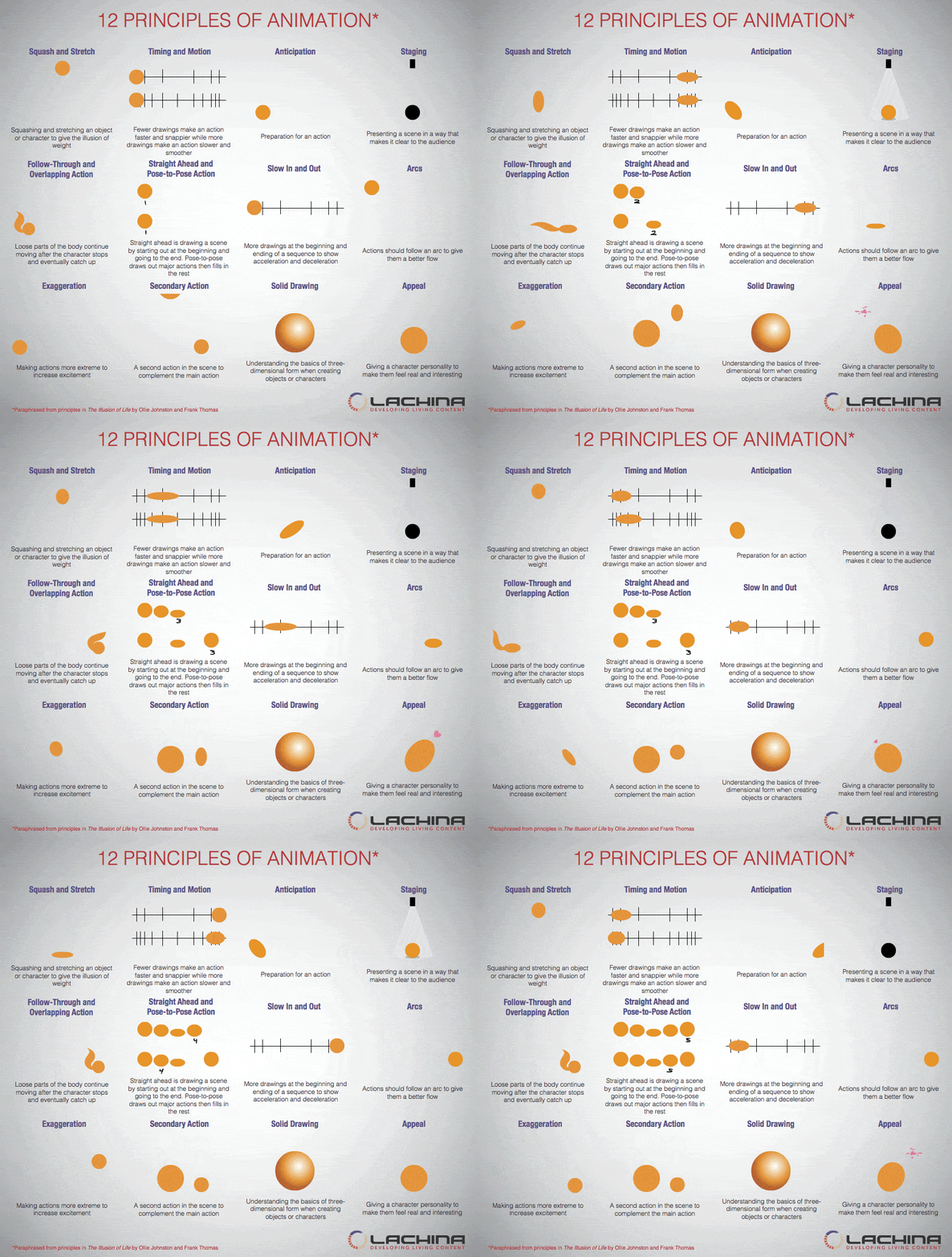
- Variants of physically-based techniques (like inverse kinematics, particle systems) that can simulate non-realistic, stylized movements according to the 12 principles of animation
- Machine learning approaches to non-photorealistic rendering and animation, as seen in Into The Spiderverse
- Neural fields. Keyframes, material, weight etc. can be parameters for coordinate-based neural networks, which can do the heavy lifting for us when physically-based simulation is impossible due to missing 3D information.
Please see my resume for details about research experience, publications, and relevant coursework.
Projects
UCSD Wushu Website
Upcoming/In progress:
Roguelike Deck-Building Game
Live2D VTuber Model
Last Updated: 5/15/2025